
Research Translation Grant
Find out the different modalities under Research Translation Grant.
Last updated on 12 October 2026
The Research Translation Grant (RTG) is NRF's primary scheme for broad-based, early-stage research translation. It complements the suite of RIE2030 initiatives supporting end-to-end strategies for priority sectors, ensuring that promising research across all sectors continues to have a pathway towards commercialisation.
RTG aims to grow the base of commercially viable assets by helping promising technologies from Singapore's public research institutions progress to a stage where they can attract private-sector interest. It also strengthens the ecosystem conditions needed to support early-stage research translation and drive commercialisation outcomes.
RTG supports research translation through two main modalities:
1. Technology Translation Projects (TTP) support projects that de-risk early-stage technologies developed by public research performers and advance them towards a stage that is attractive to investors or companies. TTP includes:
GAP@RTG
GAP@RTG supports bottom-up proposals from public research performers to advance and de-risk promising technologies to the point of commercial interest. The modality maintains broad-based support for research translation across all sectors.
VB@RTG
VB@RTG supports bottom-up proposals jointly developed by public research performers and eligible VB@RTG partners. The eligible venture builders work with research teams from an earlier stage to provide commercial guidance and help develop the technology towards an investable spin-off.
More information on the two schemes can be found in www.rgp.gov.sg/nrf-irt/ttp-rtg (opens in new tab)
2. Innovation & Enterprise Ecosystem Development Initiatives (IEDI) support national-level initiatives that strengthen capabilities and ecosystem conditions for research translation and commercialisation.
Applicant should reach out to NRF (NRF_IE@nrf.gov.sg) to discuss on the proposed programme before developing the full proposal.
From research to impact: Success stories in RIE2025
RTG builds on the Central Gap Fund and Central Core Fund under RIE2025, which supported public research institutions to mature and de-risk promising technologies towards commercialisation. The examples below illustrate how research translation funding, together with other forms of ecosystem support, helped promising technologies progress from research towards private investment and commercial use.
Nuevocor
Nuevocor’s origins can be traced to translational research conducted at A*STAR Skin Research Labs (ASRL), where a Central Gap-funded project co-led by Colin Stewart and Brian Burke further developed and validated a gene therapy approach for inherited cardiovascular diseases. The project supported further preclinical characterization and validation, which helped bridge the stage where significant scientific risk remained and further research was needed before private investors were prepared to fund the more costly late-stage development required to take the therapy into clinical trials. The resulting intellectual property and know-how were subsequently licensed by Nuevocor for further development as an A*STAR spin-off.
Subsequently, with the support of Enterprise Singapore’s T-Up programme, A*STAR Institute of Molecular and Cell Biology scientist Giulia Varsano joined Nuevocor in 2022, where she helped to further develop the therapeutic asset. She later subsequently transitioned into a full-time Senior Scientist role at Nuevocor, allowing the company to retain this specialised expertise as it expanded its drug discovery activities.
In 2025, Nuevocor secured FDA IND clearance for its lead programme, NVC-001 for LMNA-related Dilated Cardiomyopathy, enabling it to progress towards first-in-human clinical trials, and raised a US$50 million Series B in 2025 from both international and Singapore-based life sciences investors such as Kurma Partners, Angelini Ventures, ClavystBio, Boehringer Ingelheim Ventures, Coronet Ventures and EDBI. NVC-001 is now being evaluated in the Phase 1/2 SUNBEAM-LMNA trial.
Nuevocor's journey illustrates how research translation funding can de-risk promising public research towards an investible asset, with specialised talent and private capital supporting its subsequent progression towards the market.
Accelerated Materials
Central Gap funding helped transform a laboratory-scale nanomaterial manufacturing technology into a scalable platform that could attract private investment and industry interest. The underlying technology originated from research conducted through the Cambridge Centre for Carbon Reduction in Chemical Technology (C4T) programme at the Campus for Research Excellence and Technological Enterprise (CREATE), which developed highly efficient methods for nanomaterial manufacturing. While the scientific principles had been established in the laboratory, further work was required to demonstrate that the technology could operate reliably at commercially relevant scale and produce consistent product quality. NRF’s Central Gap Fund supported the development of a manufacturing platform for engineered nanomaterials, enabling the team to translate the research into a scalable production process.
Through the project, the team increased production capacity from 1 kg per day to 100 kg per day while establishing robust validation of product performance. This transformed a promising research capability into a commercialisable platform technology attractive to investors and industry.
Accelerated Materials was subsequently incorporated to commercialise the technology, with the underlying IP licensed to the company. As the technology was progressively scaled and de-risked, the company attracted private investment, including a S$3.2 million seed round led by UntroD, as well as backing from investors including SGInnovate and Cambridge Enterprise. The company has since begun working with industrial customers to apply its platform to the development and scale-up of advanced nanomaterials. Accelerated Materials illustrates how research translation funding can bridge the gap between laboratory research and commercially viable technology, with technology-transfer support, private capital and industry partnerships subsequently helping to bring the technology towards commercial use.
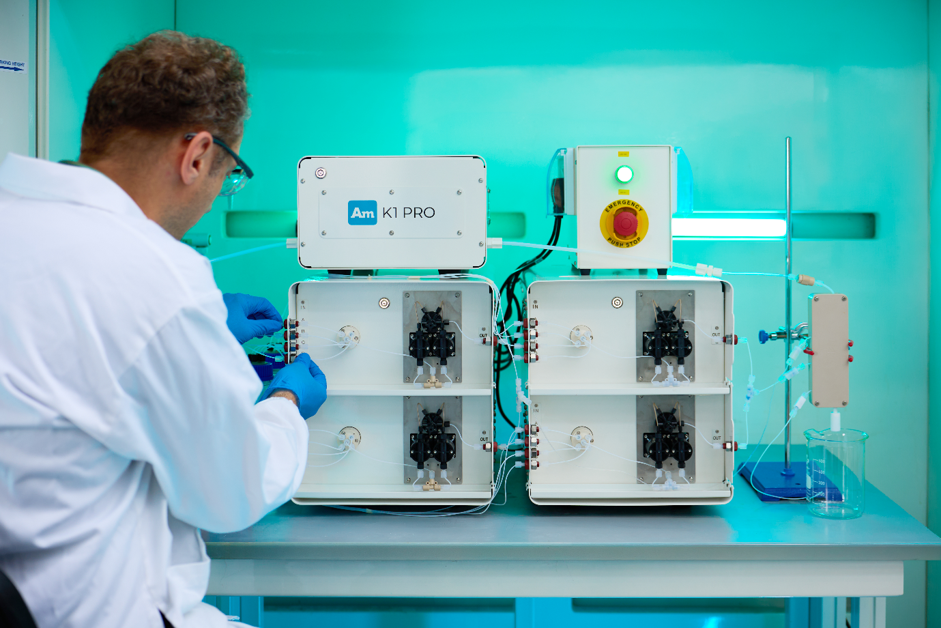
Accelerated Materials' latest microreactor system, the K1 Pro, was launched in 2026. This industrial grade, fully automated system enables high throughput synthesis of nanoparticles for R&D and small volume production.
National GRIP (the National Graduate Research Innovation Programme) is a national venture creation programme funded through the Central Core Fund and led by NUS and NTU in partnership. The programme supports researchers in translating deep-tech research into startup ventures through entrepreneurship training, customer discovery and venture-building support. Within the first two years of the programme, National GRIP has trained 126 teams and 351 people, and its first two cohorts have set up 36 companies that have raised S$7.54 million in third-party financing, demonstrating early commercial traction.
Through National GRIP, Dr Feb Hillman, an NUS researcher and Singapore Academies South-East Asia (SASEA) Fellow, commercialised NUS’ membranes technology and incorporated AeroFlux, a spin-off developing carbon capture solutions for hard-to-abate industries. While the underlying technology had demonstrated strong technical potential, further market validation, customer discovery and entrepreneurial development were required to support company formation and commercialisation. National GRIP provided structured support to assess market opportunities, refine the business proposition and develop the capabilities needed to establish the venture.
The spin-off’s patented membrane-based carbon capture solution is designed to provide a compact and energy-efficient approach for reducing industrial carbon emissions, particularly in the maritime sector. Since its incorporation, AeroFlux has secured letters of intent from ten companies across the shipping, cement and steel sectors. The company is developing its first full-scale prototype with MOL Asia Oceania and Kuok Maritime Group and is preparing to test the system on a marine engine at NUS.
AeroFlux illustrates how venture creation support can complement research translation by helping researchers develop the commercial capabilities, industry partnerships and market validation needed to transform promising public-sector research into investible deep-tech ventures
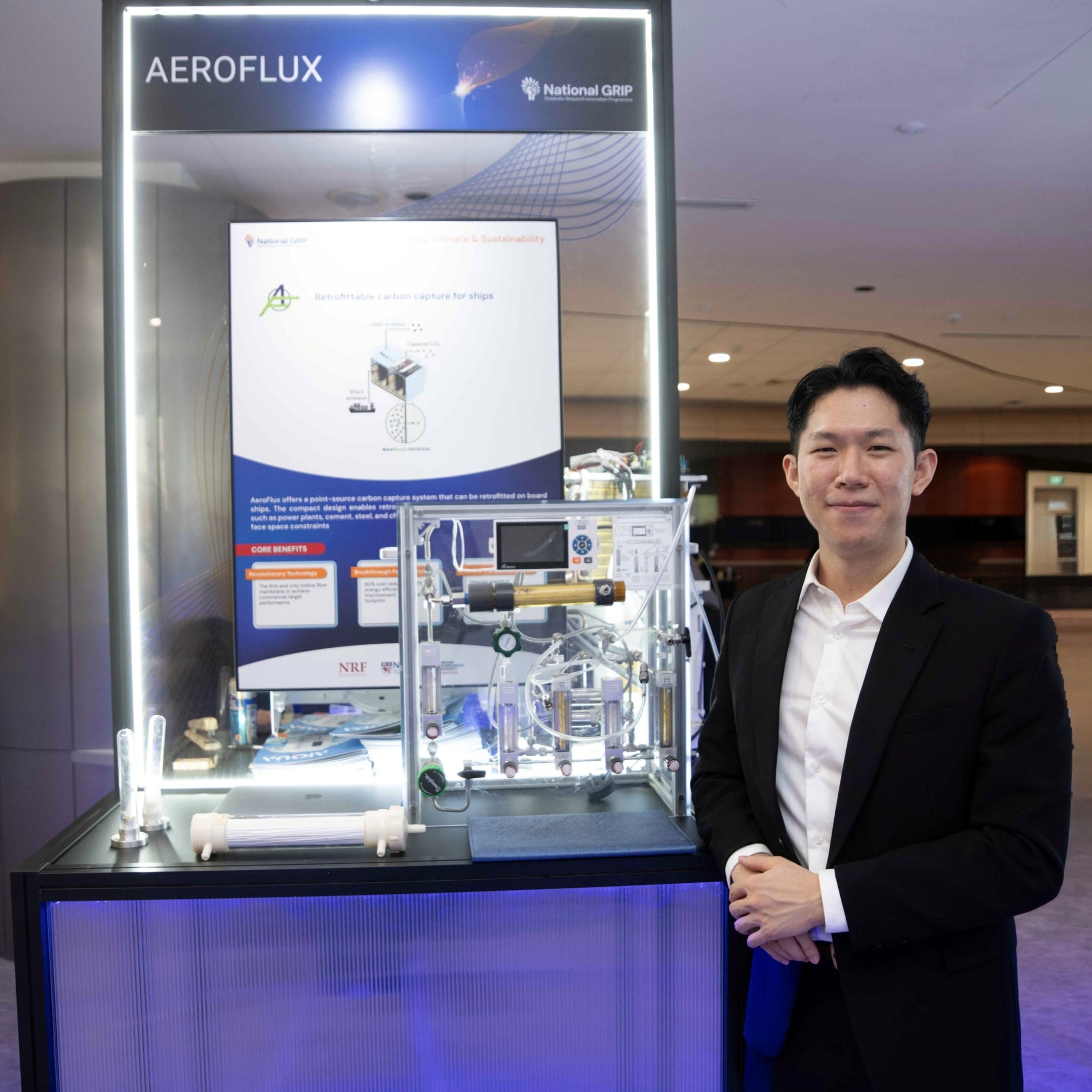
Dr Feb Hillman, founder and CEO of AeroFlux, with the company's membrane-based carbon capture prototype at a National GRIP showcase.